


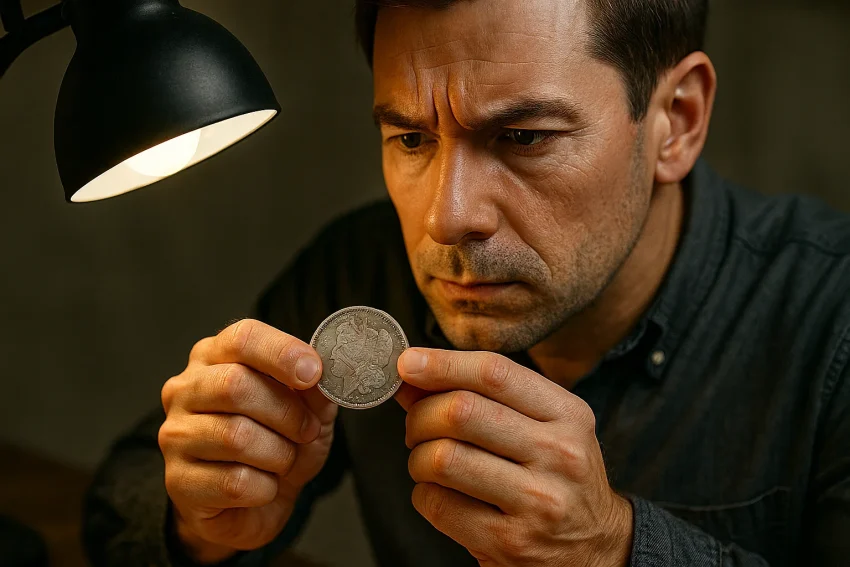
Buying a raw coin looks simple. Many collectors trust their first impression, check the date, scan the surface, and assume that the piece is worth the risk. Others rely on photos, even when the lighting hides defects.
Raw coins bring more uncertainty than graded pieces, and the price difference reflects that. The first step always starts with coin identification, but identification covers only the basic attributes. It does not show cleaning, hidden marks, tooling, or the real grade range.
Right now, we would like to discuss some practical questions that protect the buyer and remove doubts. Each question isolates a specific risk: surface alteration, attribution errors, unrealistic expectations, or weak demand. Together, they create a routine that keeps the decision grounded in observable details rather than hope.
Why Evaluating Raw Coins Is Difficult
Raw coins do not carry any third-party guarantee. There is no score, no label, and no confirmation of originality. Everything depends on observation. Many errors come from overconfidence: the surface looks bright, so buyers assume the coin is high grade; the date seems clear, so the attribution must be correct; the price looks attractive, so the defects must be small.
Most problems appear when the coin has been cleaned, altered, or stored poorly. Other issues come from misunderstanding rarity. Some dates look special but have weak demand. Some series attract few collectors, so resale becomes slow even when the coin is scarce. The following ten questions directly address these points.
Ten Essential Questions Before Buying a Raw Coin
Am I Sure the Coin Has not Been Cleaned?
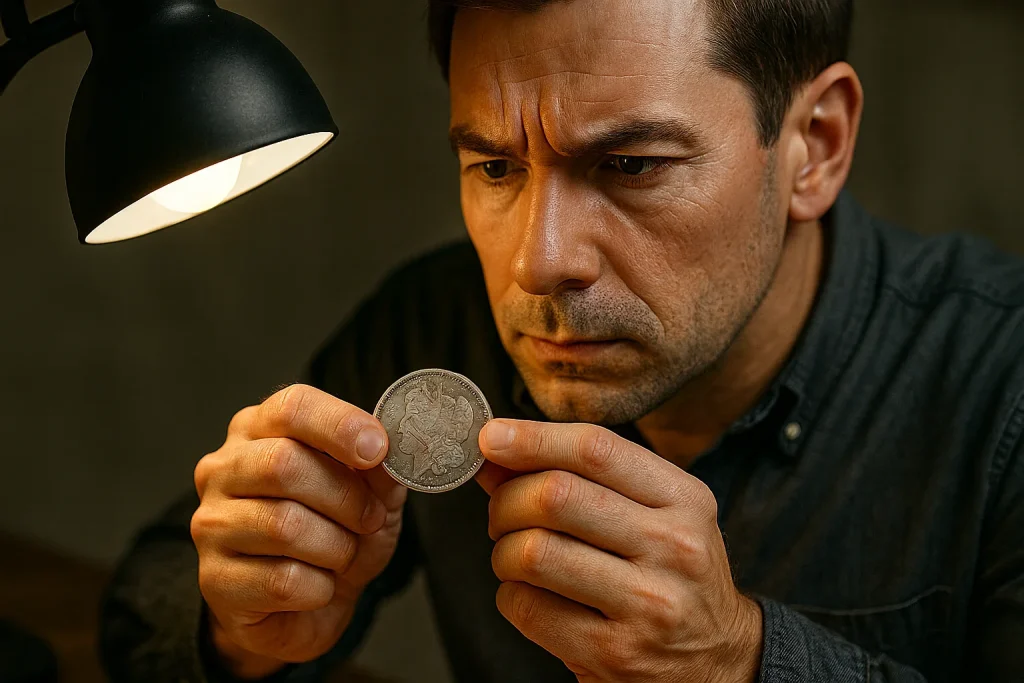
Cleaning is the most common issue with raw coins. Many cleaned pieces appear shiny and attractive at first glance, especially in dealer trays and auction photos. Under soft light, the problems become clear: flat reflection, unnatural brightness, and small parallel lines that break the original surface.
Signs to check:
- Unnatural shine that does not rotate smoothly;
- Parallel hairlines under angled light;
- Flat texture where luster should move in a cartwheel pattern.
Bright Morgan Dollars show this problem often. A dipped or polished piece may look “better,” but the price drops once the cleaning becomes visible. Cleaning removes metal, and no later restoration can recover the lost surface. A buyer must evaluate the coin from several angles, use soft, even light, and check both sides with a steady hand.
Does the Surface Show Original Texture and Luster?
Luster comes from microscopic flow lines created during striking. When these lines stay intact, the coin appears active in light and shows predictable movement. If the surface turns flat or washed, the original structure is gone. Many raw coins suffer from dull patches or uneven shine that signal past cleaning or friction.
A simple comparison helps:
| Feature | Original Surface | Altered Surface |
| Luster | Rotating cartwheel | Static, bright, flat |
| Texture | Sharp, detailed | Smoothed or dull |
Collectors should test the coin at different angles. Even a small break in luster reduces the realistic grade range. A raw coin with a strong texture is more stable in price because graders rely heavily on the integrity of the surface.
Are There Any Marks That Could Limit The Grade?
Raw coins often hide issues near the rim, fields, or devices. These marks may be small, but they still limit the grade sharply. Buyers must search for dents, deep contact points, and old scratches. Many defects blend into toned areas or sit under soft light where they appear faint.
Checklist for inspection:
- Rim dents that break the circular outline;
- Edge filing that suggests alteration;
- Deep contact marks in open fields;
- Spot corrosion that may spread.
A coin with one deep mark in the central field rarely qualifies for a high grade. Even attractive toning cannot hide structural problems. Buyers should rotate the coin slowly and use a diffused light source to expose all contact points.
Is the Coin Correctly Attributed?
Attribution errors create expensive mistakes. Some varieties look similar but differ in price by hundreds of dollars. Misidentifying overdates, mintmarks, doubled dies, and repunched marks is common among beginners. Raw coins require a careful match with a reliable reference.
This is where a coin scanner app supports the process. It helps confirm the general type, year, and country, but the buyer must still compare small markers manually.
Example cases:
- Taking a 1943/1942 Lincoln Cent for a regular strike because the overdate marker is small and easy to miss;
- Treating a minor RPM as the premium variety when the punches differ only in angle or thickness;
- Reading a weak mintmark on circulated silver as another mint because wear distorts the shape.
Attribution should be confirmed on both sides before discussing price. A single overlooked detail can change the entire evaluation.
Is the Grade Range Realistic?
Many raw coins look better than they truly are. The seller may describe the coin as “AU” even when luster breaks suggest XF. Buyers must form their own grade range using visible evidence. The goal is not to assign one number but to estimate the band within which the coin belongs.
Guide for expectations:
| Observed Detail | Possible Grade Range |
| Strong luster, light friction | AU58–MS62 |
| Visible wear on high points | XF40–AU50 |
| Soft or uneven strike | may not qualify for MS |
A realistic grade range protects the buyer from overpaying. Raw coins priced at the higher end of a range often carry more risk, while coins priced at the lower end provide better value.
Is the Price Aligned with the Grade and Demand?
Raw coins can be overpriced when sellers expect optimistic grading outcomes. Price must match both the condition and the interest in the series. Some dates sell slowly, even when they look scarce. Others sell quickly because the collector base is large.
A simple pricing routine:
- Check completed sales, not current listings;
- Compare with established guides;
- Review demand patterns within the series.
If the price assumes a higher grade than the surface supports, the risk shifts entirely to the buyer. A stable raw coin purchase rarely exceeds the value suggested by visible evidence.
Is the Coin Free from Environmental Damage?
Environmental damage affects stability. PVC residue, active corrosion, and moisture patches reduce long-term value. These problems appear slowly and may continue even after the purchase.
Warning signs:
- Green residue from aging PVC;
- Orange spotting on copper and bronze;
- Cloudy haze from moisture exposure.
Collectors should test the coin under soft light. Tilting the coin reveals texture changes that may not appear in direct light. Environmental damage often spreads, so a raw coin with early signs becomes a financial risk.
Does the Coin Show Signs of Tooling or Alteration?
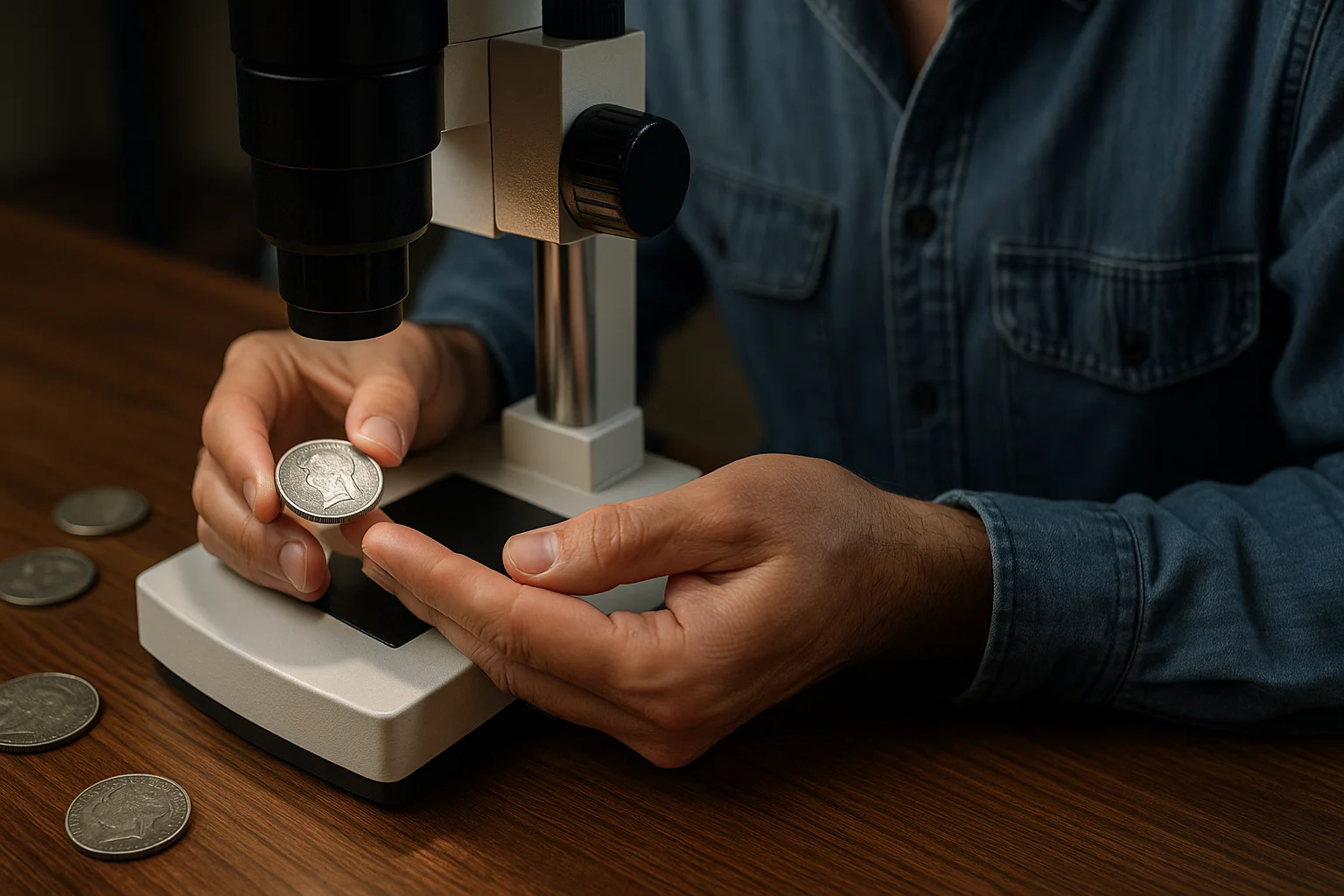
Tooling changes the original design to hide wear or improve appearance. Altered digits, sharpened feathers, smoothed fields, or repaired rims reduce authenticity and value. These changes can be subtle and appear only under magnification.
Common examples:
- Digits on Barber coins that look unnaturally sharp;
- Re-engraved feathers on early American halves;
- Smoothed surfaces on Indian Head cents to hide marks.
Alterations often appear on coins priced above typical levels for their condition. Buyers should remain cautious when the price seems inconsistent with the visible wear pattern.
Is the Coin Authentic, and Is the Risk Acceptable?
Counterfeits exist across all series, including affordable ones. Even common coins appear as fakes when the metal value or collector interest rises. Authenticity should be tested with basic checks: weight, diameter, and design style.
Three essential tests:
- Verify weight using a digital scale;
- Compare the diameter with known references;
- Study the style of letters, devices, and spacing.
And here you can also turn to the help of a free coin identifier app. For example, Coin ID Scanner helps confirm type, year, and design markers. It helps you to reveal the main things and compare them with mismatched parameters, which signal risk. Even so, authentication remains the buyer’s responsibility; digital tools support the process but do not replace manual inspection.
Do I Understand Why This Coin Is Being Sold Raw?
This question reveals the underlying risk. High-grade coins rarely remain ungraded. Most raw coins fall into one of three groups:
| Reason | Meaning |
| low grade | The grading cost exceeds the value |
| hidden problems | Сleaning, damage, alteration |
| seller uncertainty | Risk passed to the buyer |
If the coin appears high grade but is still ungraded, the buyer must assume a reason. Grading companies process thousands of submissions. Coins that truly justify grading usually end up in holders.
What These Ten Questions Reveal About Raw Coins
These questions expose the real challenge of buying raw coins: the surface matters more than the date, and the condition matters more than the story. Many errors come from missing small details: hairlines, weak luster, rim dents, or altered marks.
Buyers protect themselves when they slow down, check the texture, confirm attribution, and refuse assumptions. The more consistent the evaluation, the more predictable the long-term results.
Raw coins also demand realistic expectations. Even attractive pieces may not justify higher grades. Many dates carry stable prices because the collector base is small. These factors must be considered before negotiating or making offers.
How to Use These Questions During Inspection
Collectors improve results when they follow a steady routine. Raw coins require consistent conditions and the same tools during each inspection.
A practical sequence:
- Inspect under soft light;
- Use a 5×–10× loupe;
- Check both sides for marks and cleaning traces;
- Take clear photos for later review;
- Confirm the main coin’s details through the Coin ID Scanner app;
- Compare the visible condition with recorded sales.
Following the same process each time reduces missed details. It also creates a small archive that shows patterns across purchases.
Raw Coins Reward Careful Buyers
Raw coins offer opportunities, but they carry more responsibility. Careful inspection protects the budget and supports long-term growth of the collection. The buyer gains control when each decision comes from the surface, the structure of the market, and the realistic grade range.
Try the coin identification apps to simplify the first step, but remember that buying raw coins becomes safer when these ten questions guide the process and when assumptions give way to measured, visible facts.