


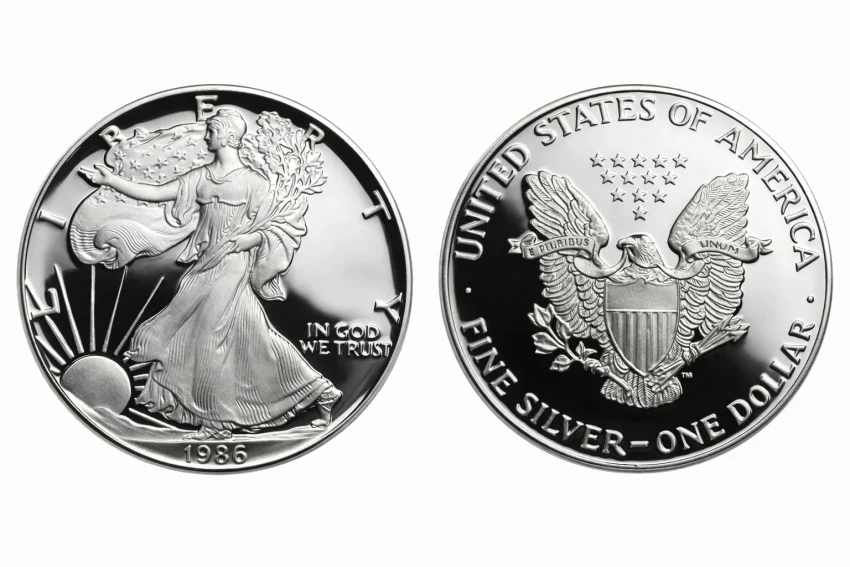
The 1986 Silver Eagle starts with one simple fact: it is the first year of the American Silver Eagle series. That gives the coin instant collector appeal. The year includes a bullion issue and a proof issue, and the price logic is not the same for both.
That is why this date stays relevant. One buyer sees a one-ounce silver bullion coin. Another sees the opening issue of a major U.S. series. A third looks only at the holder and the grade. All three views matter, but they do not lead to the same value range.
What Is a 1986 Silver Eagle?
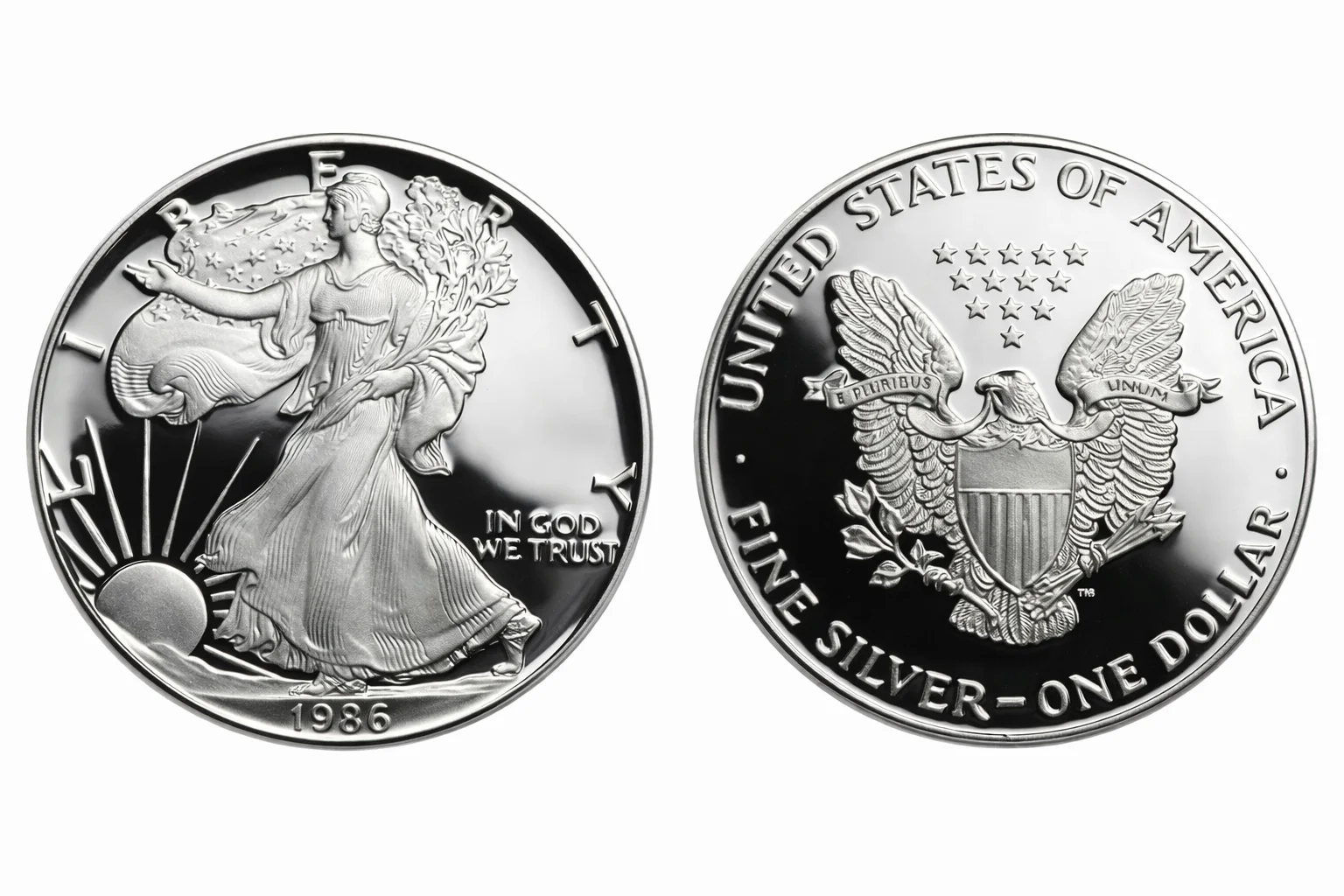
The 1986 American Silver Eagle is a one-dollar coin backed by one troy ounce of .999 fine silver. The U.S. Mint introduced the American Eagle program in 1986, and the Silver Eagle became the official silver bullion coin of the United States.
The design uses Adolph A. Weinman’s Walking Liberty on the obverse and John Mercanti’s heraldic eagle on the reverse. The basic specifications are the same for the main 1986 formats.
| Feature | 1986 Silver Eagle |
| Coin type | American Silver Eagle |
| First year of issue | Yes |
| Metal | 1 troy ounce .999 fine silver |
| Face value | $1 |
| Diameter | 40.60 mm |
| Weight | 31.10 g |
| Edge | Reeded |
| Main versions | Bullion and 1986-S Proof |
Those shared specifications matter, but they do not explain the market by themselves. The more useful split is this: bullion coin first, proof coin second. That is the real starting point for value.
Bullion Coin and Proof Coin: Two Different Markets
The bullion 1986 Silver Eagle was made for investors. The mintage is 5,393,005. It has no mint mark. The proof was made for collectors, and the proof mintage was issued in 1,446,778 pieces. That is a much smaller number, but it is still a popular and widely available proof issue in the series.
The difference is easier to see in a direct comparison.
| Version | Mint mark | Purpose | Mintage | Main price driver |
| 1986 bullion | None | Bullion issue | 5,393,005 | silver content, grade, first-year demand |
| 1986-S proof | S | Collector coin | 1,446,778 | proof quality, contrast, grade |
That table explains why the two coins should not be priced together. A raw bullion piece still begins with silver value and first-year demand. A proof begins with the collector demand and proof standards. The same date leads to two separate price curves.
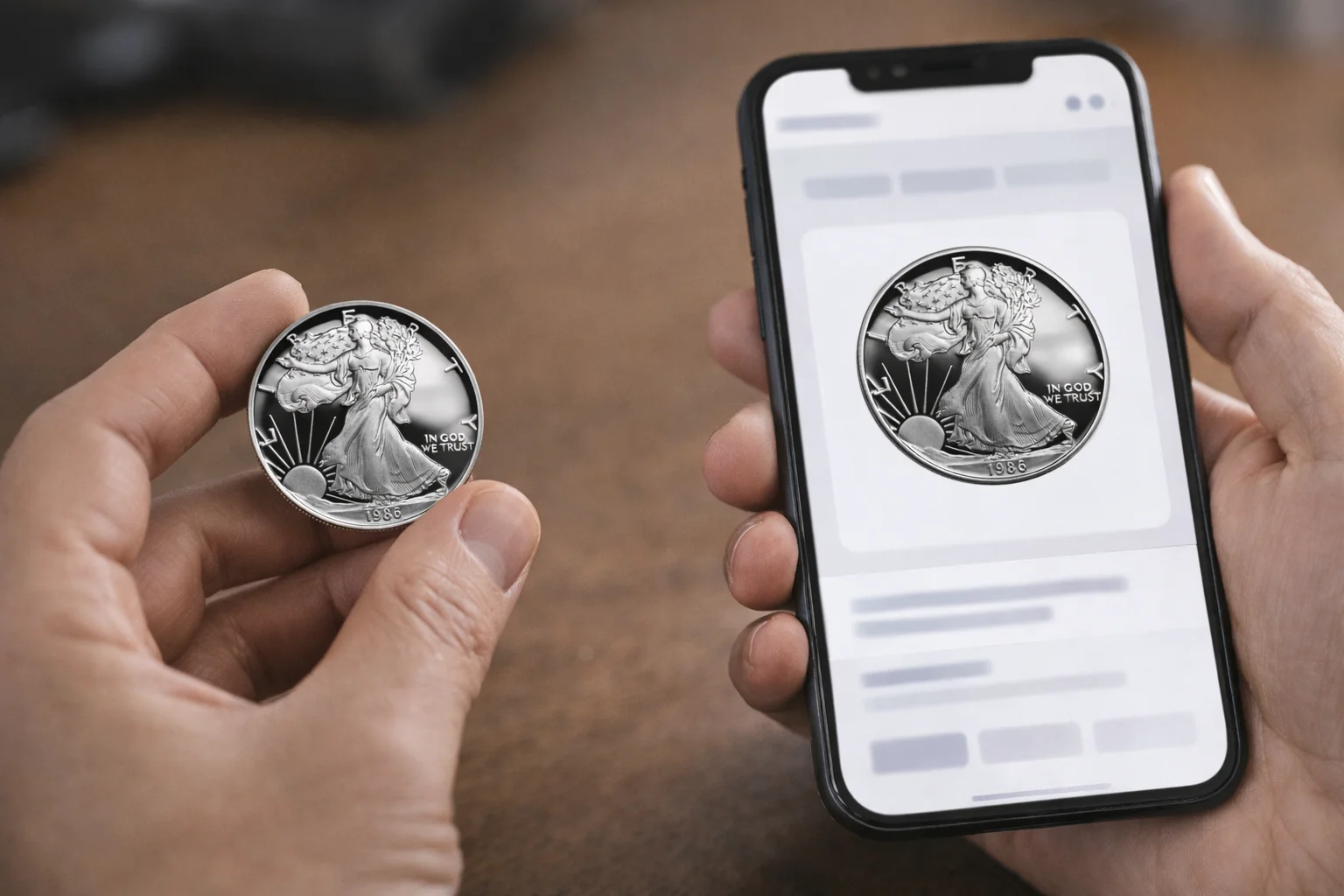
Here you can refer to the coin value checker. On a date that exists as both a bullion coin and a proof, the value is not just in a quick lookup. So, Coin ID Scanner helps more when the checker keeps coin cards, saved examples, and market ranges in separate groups, so the bullion coin is not compared to the proof as if both belong to one lane.
Why First-Year Status Still Matters
The 1986 issue matters because it opens the series. That status does not make the coin rare by itself, but it does keep demand strong. The Mint sold over five million bullion coins in the first year. That is a large number. It limits raw rarity. It does not limit collector interest.
This is the first main tension in the market. The coin is historically important, but the bullion issue is not scarce in raw form. The result is a split:
- Raw bullion coin: common first-year silver;
- Certified high-grade bullion coin: stronger premium;
- Proof coin: collector market from the start.
That is why the date keeps drawing attention. It is not a key rarity in the usual mintage sense. It is a first-year coin with strong demand and a much stronger ceiling in top grades.
The Bullion 1986 Silver Eagle
The bullion coin is the simpler side of the market. It is a one-ounce silver piece first. In raw form, it usually trades as silver plus a modest first-year premium. The high mintage keeps it from becoming scarce as an unslabbed coin. CoinWeek makes the same point directly: the 1986 bullion coin is not rare, and its raw premium is modest compared with top certified pieces.
Grade changes the picture. A certified MS69 already sits in a different tier from a raw coin. PCGS auction records show an MS69 sale at $75 in March 2023. That is not an extreme result, but it is clearly above normal bullion logic.
The larger jump comes at MS70. PCGS lists the auction record at $21,150 for MS70, with later sales also showing strong but far lower levels, including $7,637.50 in 2015. The lesson is simple. The top grade creates a premium market of its own, but that market can be volatile. It does not move like raw silver.
A short grade ladder explains the bullion side well:
- Raw: bullion value plus first-year appeal;
- MS69: collector premium begins;
- MS70: top-grade premium market.
The 1986-S Proof Silver Eagle
The proof coin belongs to a different category from the start. The 1986-S proof was extremely popular, and the Mint sold over 1.446 million examples. The original issue price was $21. This is not a low-mintage proof by modern Silver Eagle standards, but it still carries a separate collector profile.
The proof market is driven by surfaces, contrast, and grade. A proof is judged by mirrors, marks, and overall preservation. That is why a mid-grade proof can remain accessible while a top-grade PR70DCAM can move much higher. PCGS auction records show a PR69DCAM sale at $73 and an overall proof auction record of $16,115.
This makes the proof easier to read than the bullion coin in one sense. The proof is not trying to be both an investor coin and a collector coin at once. It starts as a collector issue. The question is not whether it is collectible. The question is how strong the quality is.
1986 Silver Eagle Value Overview
The broad market picture becomes clearer when the bullion and proof are separated.
| Version | Lower-range market | Where premiums begin | What moves the price most |
| Raw bullion | silver-driven | first-year premium only | silver market and demand |
| Bullion MS69 | clear collector tier | certified grade | grade and holder |
| Bullion MS70 | top premium tier | MS70 | scarcity in top grade |
| Proof mid-grade | collector premium | strong proof grades | surface quality |
| Proof PR70DCAM | top proof tier | PR70DCAM | proof quality and top grade |
This table shows the real shape of the date. The bullion coin starts as an investment piece with collector interest layered on top. The proof starts as a collector piece with silver content in the background. The strongest premiums appear when certification and grade take over the conversation.
When Is It Still Bullion, and When Does It Become a Collector Coin?
The answer depends on the version and the grade.
A raw bullion 1986 Eagle is still a bullion coin first. It is a first-year piece, but it remains common enough that silver and market spread do most of the work.
A certified MS69 starts to behave more like a collector coin. It still has bullion underneath it, but the holder and grade already matter.
An MS70 is a different product. At that point, buyers are not paying for one ounce of silver. They are paying for the top grade on the first year of the series.
The proof follows its own path. It starts as a collector coin. A mid-grade proof stays accessible. A high-grade DCAM proof moves into a much stronger premium lane.
This is why the title question has three valid answers. The 1986 Silver Eagle is a first-year coin. It is also a bullion issue. In the right grade or format, it is clearly a collector’s piece.
What Buyers Often Read Wrong
The first mistake is easy to spot. Some buyers assume the first year means rare. That is not true for the raw bullion coin. More than five million were sold in 1986. Demand is strong. Scarcity is not.
The second mistake is mixing bullion and proof values. They do not belong together. One starts in the investor market. The other starts in the collector market.
The third mistake is overpaying for the slab without checking the grade level. A slabbed 1986 Eagle is not automatically expensive. The real break comes in the upper certified grades, especially MS70 and PR70DCAM.
FAQs
Is the 1986 Silver Eagle the first coin in the series?
Yes. The American Eagle program began in 1986, and the Silver Eagle started there.
Is the 1986 bullion Silver Eagle rare?
Not in raw form. The mintage was 5,393,005, so the coin is widely available as a bullion issue.
What is the difference between the 1986 bullion coin and the 1986-S proof?
The bullion coin was made for investors and has no mint mark. The proof was made for collectors and carries the S mint mark.
Does first-year status add value?
Yes, but not equally in all formats. It supports demand, especially in certified grades, but it does not make the raw bullion coin scarce.
Is MS70 where the larger premium begins?
Yes. The strongest bullion premiums begin at MS70, not at the raw level. Rely on free coin apps like the Coin ID Scanner to know the estimated market levels as a starting point.
Conclusion
The 1986 Silver Eagle works in three ways at once. It is the first year of the series. It is a bullion coin in raw form. It becomes a stronger collector piece when the grade or the proof format changes the market. That is why the date keeps drawing attention. It is common in one lane, much less common in another, and very expensive in the best-certified levels.